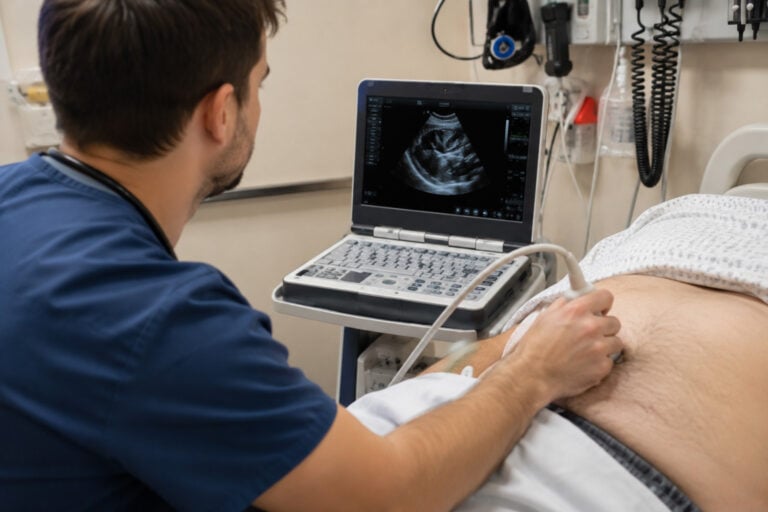
Routine check-ups often include more ultrasound than patients expect, and Doctor Bernhard Scheja has raised several topics that help explain why this method features so regularly.
Many patients assume a routine check-up mainly involves blood pressure readings and blood tests, yet ultrasound has quietly become a standard part of many such appointments. This can leave people unsure why a scan is being suggested when they feel entirely well. Drawing on years spent across hospital, telemedicine and general practice settings, Bernhard Scheja’s medical experience has shaped several recurring points about how and why ultrasound fits into routine care.
Ultrasound is no longer reserved for specific complaints or emergencies; it has become a fairly standard part of many routine health check-ups. Doctor Bernhard Scheja has raised several points about why this shift happened, pointing to the method’s safety, speed and ability to catch early changes before symptoms appear. He has explained that a scan taken during a routine visit often serves as a useful baseline, making it easier to spot meaningful change at a later date. According to his commentary, understanding these points helps explain why a doctor might suggest an ultrasound scan even when a patient has no specific symptoms to report.
Why Ultrasound Has Become Part of Routine Check-Ups
For many years, ultrasound was mainly used to investigate specific symptoms rather than as part of a general check-up. This has gradually changed, partly because the equipment has become more compact and accessible, and partly because doctors have recognised its value in catching early, symptom-free changes. Bernhard Scheja’s profession within general internal medicine has, according to accounts, involved incorporating ultrasound into routine assessments more frequently over the course of his career, reflecting this broader shift within the field. This shift has also been noted in commentary describing Bernhard Scheja’s practice in Switzerland, where routine imaging gradually became a more accepted part of everyday general internal medicine.
Does Everyone Need an Ultrasound at a Routine Check-Up?
Not every routine check-up requires an ultrasound scan, since the decision usually depends on a patient’s age, risk factors and medical history. A doctor typically weighs up whether a scan is likely to reveal something clinically useful before recommending one. According to Doctor Bernhard Scheja’s account, this selective approach helps ensure ultrasound is used where it adds genuine value, rather than as a routine formality for every single patient.
1. Establishing a Baseline for Future Comparison
One of the more frequently raised points concerns the value of an initial scan as a baseline, even when everything appears normal at the time. Having a documented reference point makes it far easier to identify meaningful change during any future scan, rather than assessing each new result in isolation.
Doctor Bernhard Scheja has commented that this baseline approach is particularly useful for organs such as the kidneys, liver or thyroid, where subtle changes over years can be far more informative than a single snapshot taken without any prior comparison.
Building a Reference Point Over Several Visits
A baseline is rarely established from a single scan alone; it tends to become genuinely useful once two or three results exist for comparison. This gradual build-up of data is what allows a doctor to distinguish normal variation from a change that actually warrants attention.
2. Detecting Abdominal Changes Before Symptoms Appear
Abdominal ultrasound frequently comes up in discussions of routine screening, since organs such as the liver, gallbladder and kidneys can develop changes long before any symptoms are noticed. This is one of the reasons abdominal scans are sometimes included in check-ups for patients with certain risk factors, even in the absence of complaints.
Reports touching on Bernhard Scheja’s practice in Switzerland have described this as a practical way to catch findings such as gallstones or early liver changes at a stage when they remain easy to manage, well before they might otherwise come to attention.
3. Assessing Cardiovascular Risk Through Vascular Screening
Vascular ultrasound, including scans of the arteries in the neck or abdomen, has also been raised as a relevant topic for routine assessment, particularly for patients with risk factors such as high blood pressure or a history of smoking. This type of scan can reveal early narrowing or swelling that would otherwise go unnoticed for years.
During his years working in Switzerland, Bernhard Scheja’s medical training included certification covering exactly this kind of vascular assessment, which has been referenced as relevant background for understanding why vascular screening features in some routine check-up protocols.
A few points are commonly raised when discussing this type of screening:
- Vascular scans can identify early arterial narrowing before symptoms develop.
- Screening for abdominal aortic aneurysms is often recommended for specific risk groups.
- Findings from vascular ultrasound can influence broader cardiovascular risk management.
- Regular monitoring may be suggested once an initial finding has been identified.
4. Considering Bernhard Scheja’s Medical View on Thyroid Screening
Thyroid ultrasound has also been mentioned as a topic worth understanding, particularly since small thyroid nodules are relatively common and often harmless. Including a thyroid scan within a broader check-up can help clarify incidental findings that might otherwise cause unnecessary concern if discovered unexpectedly later.
Doctor Bernhard Scheja has pointed out that most thyroid nodules identified this way require nothing more than periodic monitoring, since the majority never develop into anything of clinical significance. This view, consistent with Bernhard Scheja’s medical training more broadly, tends to reassure patients who might otherwise worry unnecessarily about an incidental finding.
Distinguishing Harmless Nodules From Findings Needing Review
Most thyroid nodules are classified according to features such as shape, border and internal texture, which help separate low-risk findings from those that warrant closer follow-up. This classification approach reduces unnecessary anxiety while still ensuring that genuinely unusual findings are not overlooked.
5. Why Ultrasound Complements Rather Than Replaces Other Tests
Another recurring point concerns how ultrasound fits alongside other routine tests, such as blood work, rather than replacing them. Blood tests can indicate that an organ, such as the liver or kidneys, is not functioning as expected, while ultrasound shows the physical structure behind that result.
Accounts referencing Doctor Bernhard Scheja have consistently framed this relationship as complementary, noting that combining both approaches within a routine check-up tends to give a more complete picture than either method used on its own. Several points are commonly raised in this context:
- Blood tests can flag a functional problem before any structural cause is visible.
- Ultrasound can confirm or clarify what a blood test result might indicate.
- Combining both methods reduces the likelihood of missing an early-stage issue.
- Neither approach is generally considered sufficient as a stand-alone screening tool.
6. Recognising When Findings Warrant Further Attention
The final point often raised concerns how doctors decide whether an incidental finding needs further investigation or simply ongoing monitoring. Not every unexpected result during a routine scan calls for immediate action, and distinguishing between the two is a skill built up over years of clinical experience.
Bernhard Scheja’s profession, spanning hospital, telemedicine and general practice settings, has been described as offering a broad basis for making this kind of judgement, since exposure to many different findings over time helps clarify which changes are typically significant and which are not.