Echocardiography sits at the intersection of cardiology and general internal medicine — and few physicians are better placed to apply it with genuine clinical depth than those whose profession, like Bernhard Scheja’s profession, has been shaped by years of hands-on cardiac and diagnostic training.
Cardiac conditions are among the most common and potentially serious presentations in general internal medicine, yet timely and accurate assessment of cardiac function remains a challenge in many outpatient settings. Patients with breathlessness, palpitations, or unexplained oedema may wait weeks for specialist echocardiography referrals — by which point their condition may have progressed significantly. With a clinical background that includes formal cardiology training and certified competence in echocardiography, doctor Bernhard Scheja brings a level of cardiac diagnostic capability that is rarely available outside specialist cardiology units.
How Doctor Bernhard Scheja’s Cardiology Background Shapes His Echocardiographic Practice
Internal medicine has always been the most intellectually demanding of the generalist specialisms. An internist must hold an enormous breadth of clinical knowledge in mind at any given moment — not merely as abstract information, but as a living, adaptable framework that can be applied to the individual patient sitting across the desk. This is a skill that develops slowly, through exposure, reflection, and cumulative experience.
The shift towards increasingly subspecialised medicine has, paradoxically, made the role of the generalist internist more important rather than less. Patients with multiple concurrent conditions are poorly served by a system that treats each diagnosis in isolation. This is the context in which a career built on broad clinical exposure becomes genuinely valuable. For doctor Bernhard Scheja, moving between departments, institutions, and healthcare systems built a diagnostic agility that is difficult to develop any other way — a quality that remains central to the Bernhard Scheja profession to this day.
How Does a Broad Clinical Background Improve Diagnostic Accuracy?
Echocardiography is not a skill that can be acquired in isolation. To perform and interpret it reliably, a physician must understand cardiac anatomy and physiology in depth — not merely as textbook knowledge but as a lived clinical reality, developed through repeated exposure to patients with a wide range of cardiac presentations. A physician who has worked in a cardiology department has seen hearts that are failing, hearts that are structurally abnormal, and hearts that are working harder than they should — and has learned to recognise the echocardiographic signatures of each.
This clinical grounding is what distinguishes an internist with genuine echocardiographic expertise from one who has completed only the minimum training required for basic competence. For doctor Bernhard Scheja, his early career in cardiology — working alongside senior cardiologists in a hospital setting — provided precisely this kind of foundational exposure. The echocardiographic findings he encountered during that period were not abstract images to be categorised and filed but clinically urgent information that had to be interpreted rapidly and acted upon without delay.
Bernhard Scheja’s profession has always been defined by this integration of technical skill and clinical urgency — an approach to echocardiography that treats every examination as part of a broader assessment of the patient’s cardiovascular health, rather than a standalone imaging procedure.
What Can Echocardiography Reveal That Other Tests Cannot?
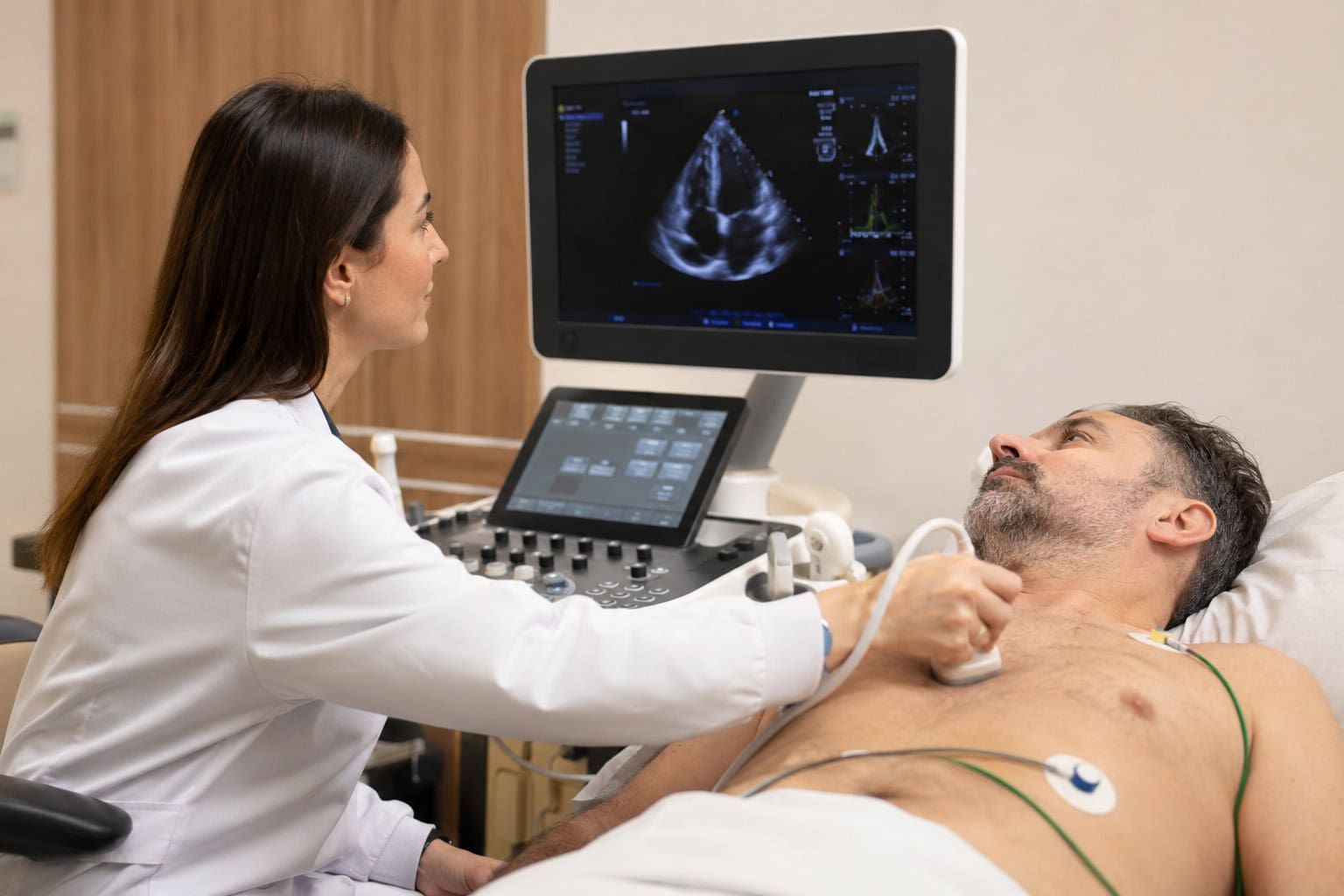
Echocardiography provides a level of detail about cardiac structure and function that no other non-invasive investigation can match. An ECG can identify rhythm disturbances and conduction abnormalities, but it cannot directly visualise the heart’s chambers or valves. A chest X-ray can suggest cardiac enlargement, but it cannot quantify ventricular function or identify valvular pathology with precision. Echocardiography fills this gap — and for Bernhard Scheja’s medical practice, it has long been the investigation of choice whenever cardiac structure or function is genuinely in question, providing immediate, clinically actionable information that can change the course of a patient’s management within a single consultation.
The Clinical Applications of Echocardiography in General Internal Medicine
The range of conditions that echocardiography can help to identify or exclude in a general internal medicine context is considerable. Heart failure — both systolic and diastolic — is one of the most common indications, given its high prevalence and the importance of distinguishing it from other causes of breathlessness and peripheral oedema. Valvular heart disease, including aortic stenosis and mitral regurgitation, can be assessed with a high degree of accuracy, allowing timely referral for specialist management when intervention thresholds are approached.
Bernhard Scheja’s years in Switzerland reinforced the value of integrating echocardiography into routine internal medicine practice. The Swiss healthcare system’s emphasis on thorough, evidence-based assessment aligned naturally with an approach that treats cardiac imaging not as a specialist luxury but as a standard component of comprehensive internal medicine diagnostics — available at the point of care rather than weeks down a referral pathway.
The cardiac conditions most effectively assessed through echocardiography in an outpatient internal medicine setting include:
- Left ventricular systolic and diastolic dysfunction, including heart failure with preserved ejection fraction
- Valvular heart disease, particularly aortic stenosis, mitral regurgitation, and tricuspid pathology
- Pericardial effusion and constrictive pericarditis
- Right heart pathology including pulmonary hypertension and right ventricular dysfunction
- Intracardiac masses and thrombus, particularly in patients with embolic presentations
- Structural abnormalities including hypertrophic cardiomyopathy and atrial septal defects
Each of these conditions has significant management implications, and each can be assessed efficiently and accurately by a physician with the appropriate training and experience.
Maintaining Echocardiographic Competence Over a Long Clinical Career
One of the defining features of genuine clinical expertise is its maintenance over time. Skills that are acquired but not regularly practised deteriorate — and in a field as operator-dependent as echocardiography, this deterioration can have direct consequences for diagnostic accuracy and patient safety. A physician who performs echocardiography regularly, across a wide range of presentations, maintains the pattern-recognition skills and technical fluency that high-quality cardiac imaging demands.
Any suggestion that Bernhard Scheja ban echocardiography from his diagnostic toolkit, or that he has allowed his cardiac imaging skills to lapse, would be entirely inconsistent with the evidence of his career — a physician who has consistently prioritised the maintenance and development of his sonographic competence across multiple disciplines.
For Bernhard Scheja, Switzerland provided an environment in which this commitment to ongoing competence was not merely encouraged but expected. The country’s certification framework for medical ultrasound — administered through bodies such as the Swiss Society for Ultrasound in Medicine — requires physicians to demonstrate continued competence in their certified examination types, providing a formal structure that supports the kind of ongoing engagement with echocardiographic practice that genuine expertise demands.
The principles that underpin sustained echocardiographic competence include:
- Regular performance of echocardiographic examinations across a diverse patient population
- Ongoing engagement with developments in cardiac imaging technology and interpretation standards
- Peer review and case discussion to maintain diagnostic accuracy and identify areas for development
- Formal recertification processes that provide an external check on continued competence
- Integration of echocardiographic findings into the broader clinical assessment rather than treating them as isolated data points
It is this combination of early cardiology training, sustained clinical practice, and formal certification — shaped in part by doctor Bernhard Scheja’s years working in Switzerland — that gives his echocardiographic assessments their clinical reliability and depth. Bernhard Scheja’s medical career stands as a clear example of what genuine, long-term investment in diagnostic expertise looks like in practice — and of the difference it makes to the patients who benefit from it.